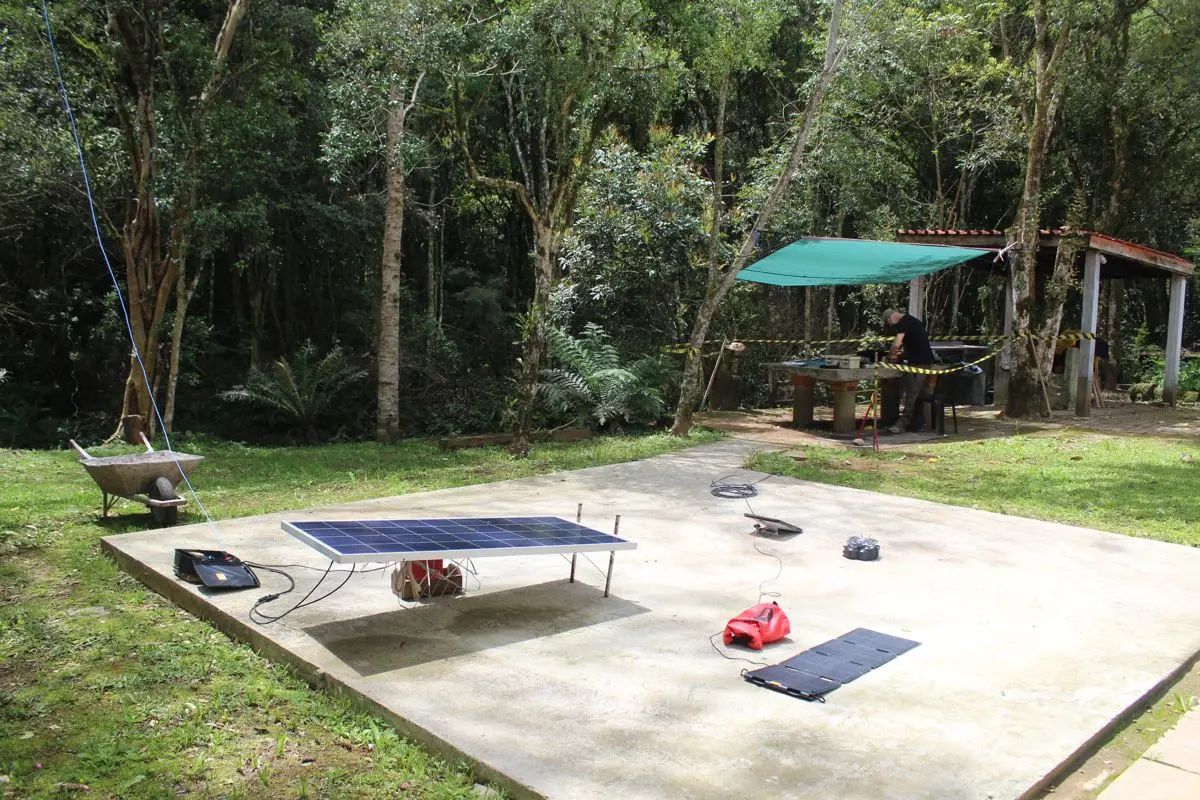
Off-grid communication: how do you keep the response running when power and the internet go down?
In this series of Project Journals, we present the technologies we are investigating as part of a toolkit for rapid response to incidents and climate disasters. In the journal on satellite internet, we saw that the antenna only stayed on with some power sources. In this journal, we look at what supports every piece of the kit: power. What happens when everything goes down at once? In a flood, the power grid is usually the first thing to go down. Soon after, the mobile phone masts run out of power or are hit by the water. In a landslide, poles slide down together with the slope. In a windstorm, trees fall onto the wires and whole neighbourhoods are left in the dark for days. In a fire, the grid may be switched off on purpose to prevent new outbreaks. Those who arrive to help find a territory that is dark and silent.
November 13, 2026
Emergency communication exercise between the Base and the field team
An exercise in pairs that combines voice radio and LoRa messages: scheduled check-ins, failure of one layer and what to do when contact is lost
November 18, 2026
Which tool to use in each situation
How to choose between drone, solar power, satellite internet, Wi-Fi, radio and LoRa messages depending on the situation and the type of climate disaster
November 19, 2026
How to keep in touch between the Base and the field team
What to agree before leaving, the scheduled contact at the agreed interval, what to do when a layer fails and when the team goes silent on the radio
November 19, 2026
PACE plan and kit records
The kit's four communication layers, where each piece of equipment goes and the records the Base keeps: log, power readings and removal checklist
November 19, 2026