Your first low Earth orbit satellite connection
An exercise in pairs to set up the antenna, connect it to a portable power source and get internet to a phone
November 13, 2026
Your first solar power chain
An exercise in pairs to build the chain from the solar panel to a device, measuring the voltage before each connection
November 13, 2026
Off-grid communication: how do you keep the response running when power and the internet go down?
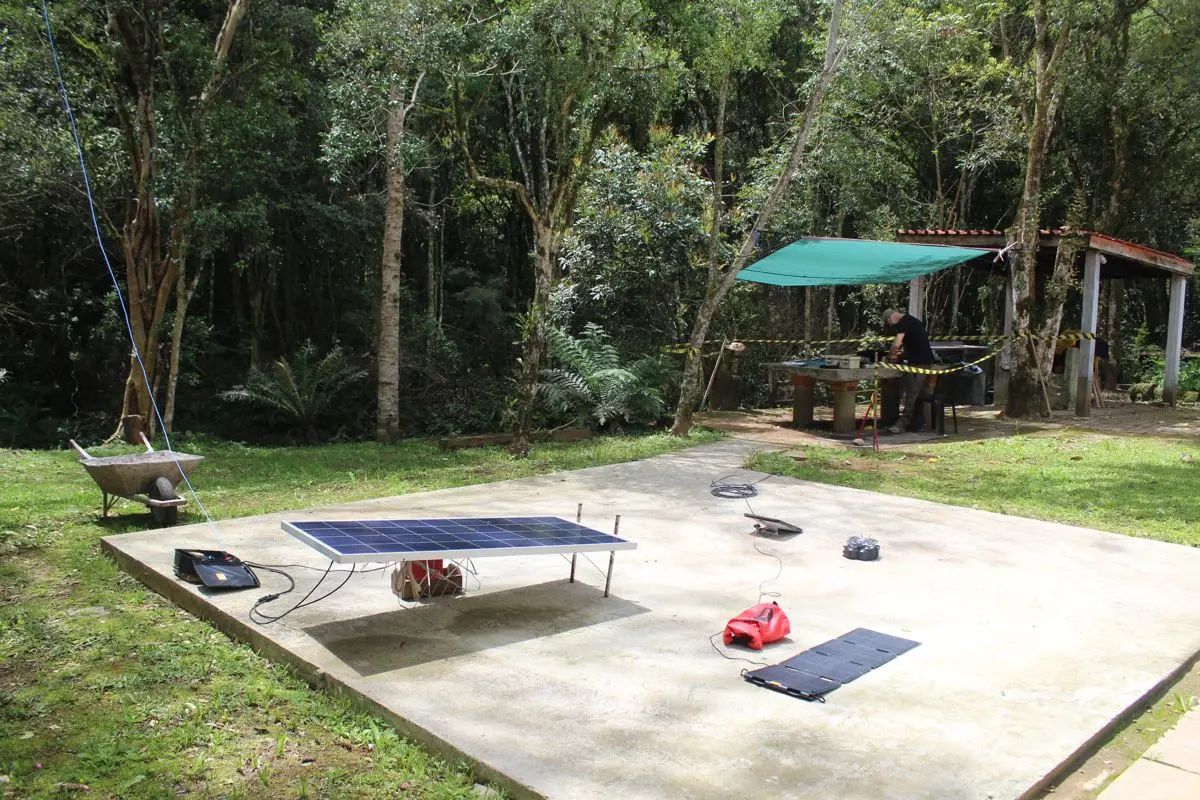
In this series of Project Journals, we present the technologies we are investigating as part of a toolkit for rapid response to incidents and climate disasters. In the journal on satellite internet, we saw that the antenna only stayed on with some power sources. In this journal, we look at what supports every piece of the kit: power. What happens when everything goes down at once? In a flood, the power grid is usually the first thing to go down. Soon after, the mobile phone masts run out of power or are hit by the water. In a landslide, poles slide down together with the slope. In a windstorm, trees fall onto the wires and whole neighbourhoods are left in the dark for days. In a fire, the grid may be switched off on purpose to prevent new outbreaks. Those who arrive to help find a territory that is dark and silent.
November 13, 2026
Cost and maintenance of the kit
Where to buy each part, what it costs to keep the kit running and why free software and batteries weigh so much in this calculation
November 16, 2026
How to set up and take down the Base
From preparing the kit before leaving to taking it down: choosing the site, setting up the shelter, switching on the layers in the right order and leaving the place as it was
November 19, 2026