How can communication be maintained in emergency situations caused by climate disasters? That is the question that drove the development of the project “Technologies for Rapid Response to Climate Incidents and Disasters - Tridecs”.
Divided into three stages, the project aims to research and develop maps of technological solutions for scenarios in which conventional communication systems and uses fail. The proposal is to map, test, and adopt viable alternatives so that communication is not interrupted, even under the worst circumstances.
The priority audience is social movements, activists, environmental defenders and public and private institutions active in incident situations, among other actors who live and work where there is a need for rapid response to climate disasters.
What Tridecs aims to do
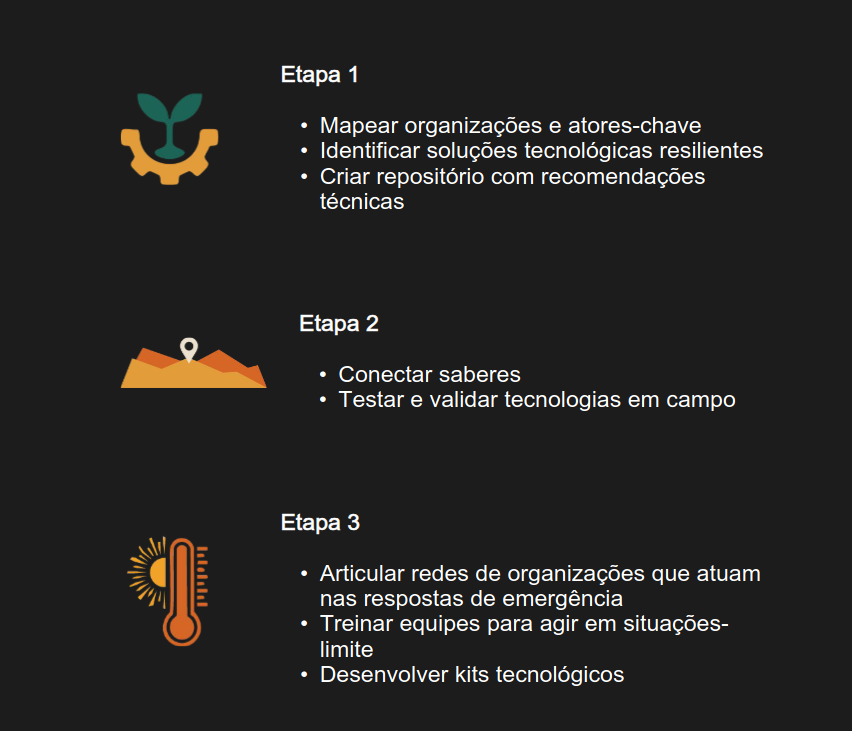
In the first phase, we mapped and evaluated communication technologies and selected the most resilient ones: low-cost, autonomous and adaptable. We also identified the main actors involved in rapid response and analyzed the most suitable technologies for each type of climate disaster. This analysis produced the three technologies that moved on to testing: local Wi-Fi, HT radios and LoRa with Meshtastic.
The result of this work is gathered in the Documentation, a repository with technical content and recommendations on each technology and the climate disasters in which it can be used.
In the second phase, now under way, the selected technologies are tested on the bench and in the field. They are being brought together into a kit in six layers, organized by function: satellite internet, local Wi-Fi network, voice, text messages, its own power supply and terrain reconnaissance. The first field test has already taken place. What works and what needs to change is published in the Project Diary at each step.
In the third phase, the validated technologies will be the basis for training to form teams prepared to act in extreme situations.
The project is implemented on a pilot basis in two Brazilian states: Rio Grande do Sul (South region) and Maranhão (Northeast region), considering their specific types of climate disasters and regional characteristics. In the long term, the plan is to create trained teams equipped with a technology kit offering specific recommendations for different types of climate disasters.
Tridecs is carried out by Nupef with support from the Digital Access Programme of the Embassy of the United Kingdom in Brazil, which has supported the project since its first phase.
Who we are
Nupef is a civil society organization that began its journey in 2005. We promote the safe use of technologies to guarantee rights and contribute to the full exercise of citizenship. We organize our work around two main programmatic areas: Right to Connectivity and Territorial Protection, and Resilient Infrastructure and Information Security.
Who makes Tridecs happen
Coordination Core: Joara Marchezini, Moacir Neto, and Zeilane Fernandes
Communications Coordination: Bruna Hercog
Supervision: Oona Castro and Rodrigo Troian
Research Team: Joara Marchezini, Carol Magalhães, Vitória Santos, Zeilane Fernandes, Moacir Neto, Flávio Hernan, Rodrigo Troian
Design and social media management: Isabella Selaimen
Hotsite development: Zeilane Fernandes
Review: Renato Racin
Learn about other Nupef projects by visiting the website nupef.org.br.