In this exercise, one person stays at the Base and another sets off on foot or by car, as a search and rescue team would. The two keep in contact using two layers of the kit: voice over the radio and text messages over the LoRa devices. Along the way, they simulate the failure of one of them and practise what to do when contact is lost. At the end, they will have a completed Base log, as in a real emergency.
Time: about 1 hour 30 minutes · People: 2 or 3 · Prior knowledge: having done Your first radio communication and knowing how to set up a Meshtastic node
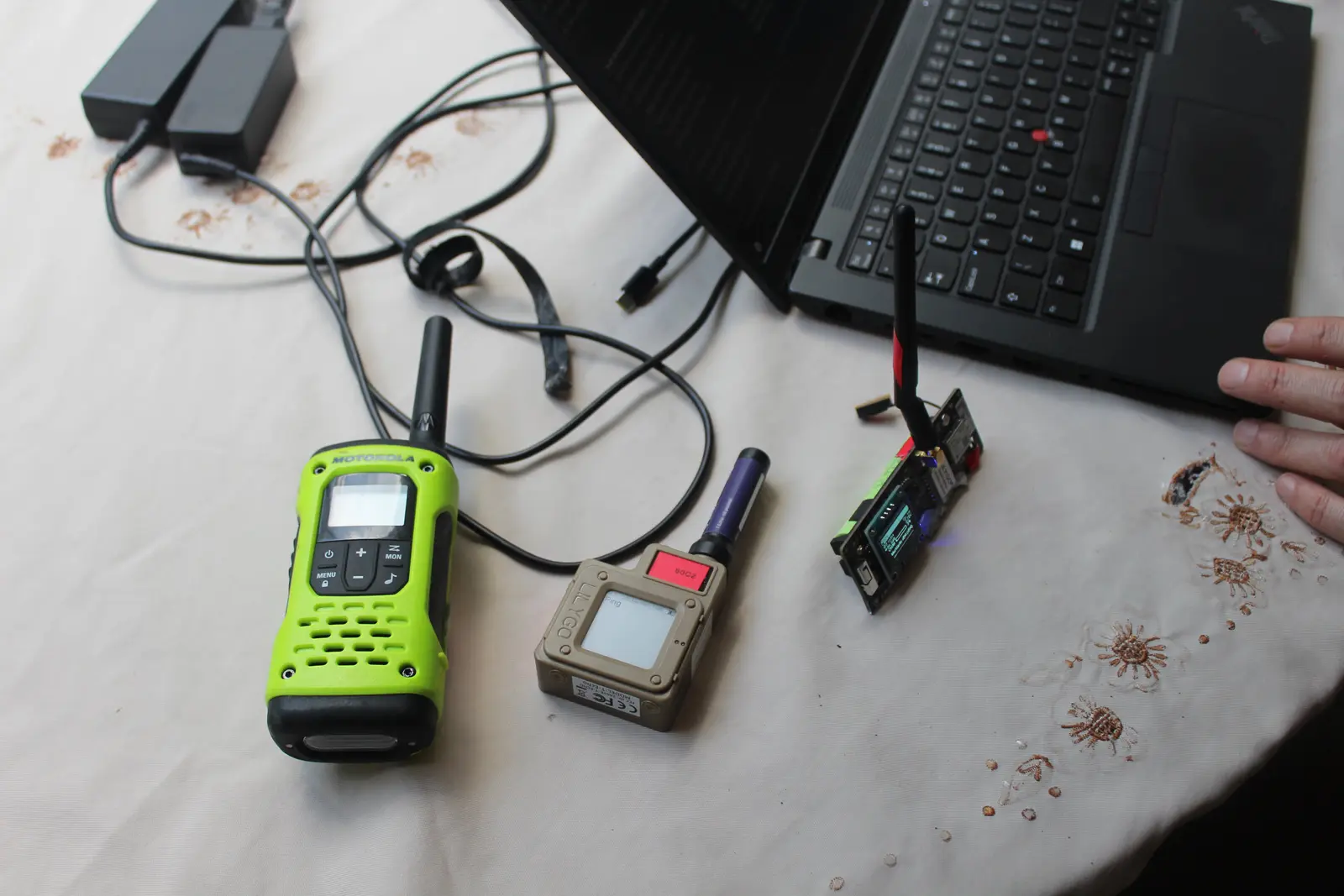
You will need
- two licence-free radios certified by Anatel, on the same channel and with the same privacy code;
- two Meshtastic devices with the same region, the same radio mode and the same channel. One stays at the Base. The other, preferably a tracker with GPS and an SOS button, goes with the person in the field;
- two mobile phones with the Meshtastic app;
- a sheet for the Base log, a pencil and the card with the agreed channels (PACE card);
- a map of the area, on paper or offline on the phone.
Use licence-free radios. Amateur radios, such as the Baofeng, may only transmit with a qualified operator (see Radio categories in Brazil and the PACE model).
1. Prepare the departure
Before the person leaves, both check together:
- The voice channel and the privacy code are the same on both radios.
- The messaging channel is the same on both LoRa devices.
- The tracker’s position appears on the app map, on the Base phone.
- The planned route, the stopping points and the return time are written in the log.
- On the map, the stretches in valleys or behind hills are marked. That is where text messages tend to fail.
2. Open the Base log
On the sheet, draw a table with these columns and write down the start time:
| Time | Who called | Layer used | Position | Situation | Next step |
|---|
Every contact, successful or not, becomes a row. In a real emergency, this log is what allows another person to take over the Base without losing anything.
3. Make the first contact by voice
- The person in the field moves away and stops at the first agreed point.
- The Base calls: “Field 1, this is Base”.
- The person in the field always answers in three parts: where they are, how they are and what they will do next.
“Base, this is Field 1. I am at the bridge on the old road, all fine, heading to the school.”
- The Base repeats the key points to confirm and writes the row in the log.
4. Send an address by message
Anything that needs to be in writing goes by text message: an address, a coordinate or a list of what is missing.
- The person in the field writes a made-up address in the app and sends it to the Base.
- They wait for the delivery confirmation in the app.
- The Base checks whether the tracker’s position on the map matches what was said by voice.
Names and addresses of real people never go by voice, because anyone with a radio can listen. Use a message, on a closed channel.
5. Simulate a voice failure
- At an agreed check-in, the person in the field does not answer on the radio.
- The Base repeats the call once.
- With no answer, the Base switches to text message and waits up to 2 minutes for the delivery confirmation.
- The person in the field answers by text, in the same three-part format.
- The Base writes in the log which layer worked.
6. Go to a low point
- The person in the field goes to a lower spot or behind a hill.
- There, they try to send a text message. If it does not arrive, they call by voice.
- While there is no clear path to the Base, voice is the main layer. Once they are higher again, they go back to sending text.
In the project’s field test, voice reached the Base at all 13 points of a car route. Text messages arrived at 9 and failed precisely in the valleys.
7. Repeat the scheduled check-in
In a real emergency, the Base calls the team at the interval the group agreed before leaving, for example every 20 minutes. In the exercise, you can agree on a shorter interval, of 5 or 10 minutes, to practise more times. What matters is that each contact happens on time and that each one becomes a row in the log.
8. Practise loss of contact on paper
Agree with the person in the field on a check-in at which they do not answer on any layer. The Base follows this sequence, without actually alerting anyone:
| Time without an answer | What the Base does |
|---|---|
| At the check-in time | Tries voice, then a message, and checks the last position on the map |
| After 2 intervals without an answer | Looks up the tracker’s last known position and considers sending a second team, if there is one |
| After 3 intervals without an answer | Alerts the search and rescue teams or the public response agencies, giving the last position, the planned route and who is on the team |
The tracker’s SOS button is for when someone is in danger and has no other means. If you want to test it, tell the Base first. When the Base receives an SOS, it writes down the time and the position and calls for rescue immediately.
9. Close the exercise
- The person in the field returns to the Base.
- Both read the log together: are all the contacts there, with time, layer and position?
- Write down what failed, where and why. This helps decide where to place a repeater or where voice should always be the first option.
What you learned
You kept in contact between the Base and a moving team using two layers that fail for different reasons. When voice failed, text covered it. When text failed in a valley, voice got through. And when nothing answered, the Base knew what to do and when. This is the logic of the PACE model put into practice.