Low Earth orbit satellite: Starlink Mini, tested power sources and costs
November 13, 2026
Quick reference data on the low Earth orbit satellite antenna used in the project, the Starlink Mini.
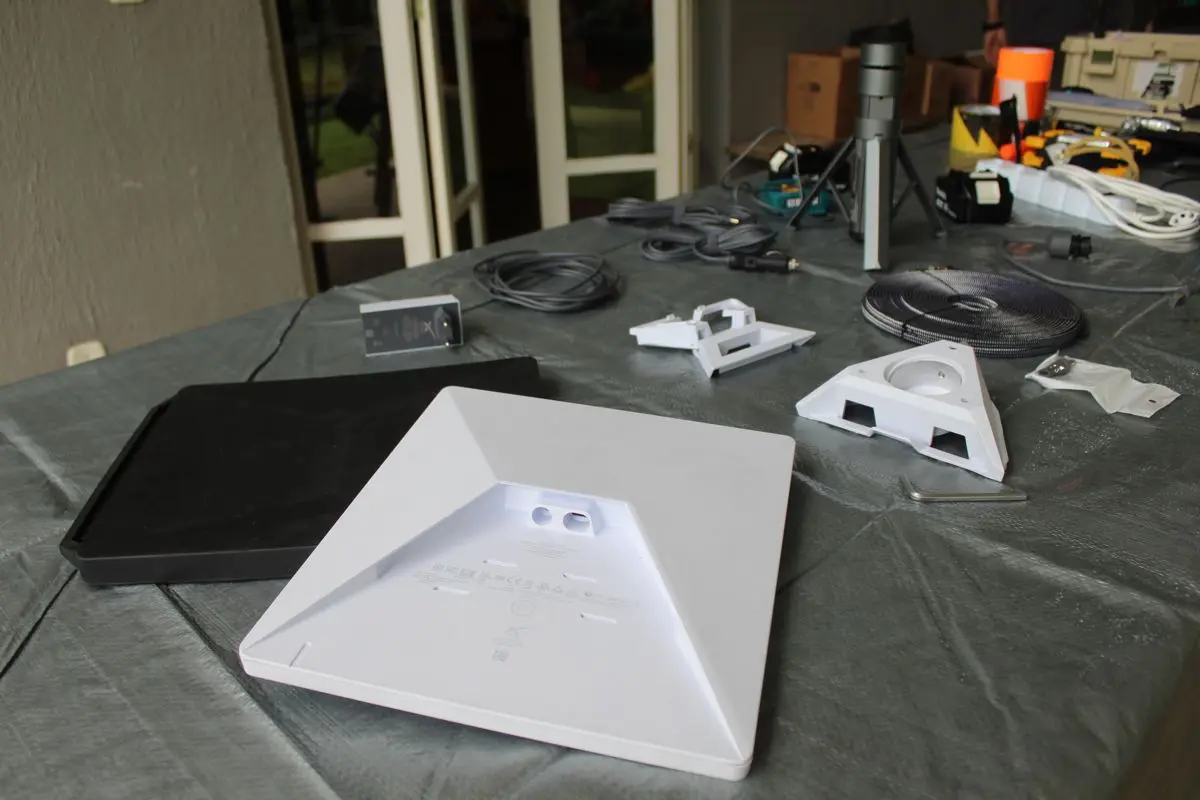
Starlink Mini specifications
Source: official Starlink specifications page.
| Item | Value |
|---|---|
| Average consumption | 25 to 40 W |
| Power input | 12 to 48 V DC (direct current) |
| USB-C power | power bank or charger with 100 W USB-C PD (20 V and 5 A), with the manufacturer’s USB-C cable |
| Weight | 1.10 kg; 1.16 kg with the stand |
| Wi-Fi | router built into the antenna itself |
What was taken to the field
| Item | Use |
|---|---|
| Starlink Mini antenna | Satellite internet at the Base |
| Cover, case and silicone cover | Transport and protection |
| Waterproof connector and mounting kit | Fixing in place in the field |
| Vehicle cable and USB-C adapter | Power from a car or power bank |
| Adapter for 18 V tool battery | Battery power |
| 5 m USB-C cable | Distance between the power source and the antenna |
Power sources tested
| Source | Result in the field |
|---|---|
| Tripod power bank, recharged by the solar panel | Stable |
| 18 V tool battery | Stable |
| Folding solar panel, direct connection | Stable |
| Base solar kit (panel, controller, battery and converters) | Worked |
| 100 W power bank with 1 m cable | Failed: the antenna kept switching on and off |
What drives the cost
| Item | Note |
|---|---|
| Monthly subscription | The only significant monthly cost of the kit. Check whether the plan can be paused outside emergencies |
| Plan reactivation | Depends on an account, a card and internet access, which may be missing in a climate disaster. Decide in advance who reactivates it and how |
| Antenna software | Closed, controlled by the manufacturer |
| Where to buy | Official website and large Brazilian retailers |
Prices change often. Check with the shop before any purchase.
See also
Last updated on