Off-grid power: kit equipment and tested paths
November 13, 2026
Quick reference data on the kit’s power, tested in the field work in Rio Grande do Sul.
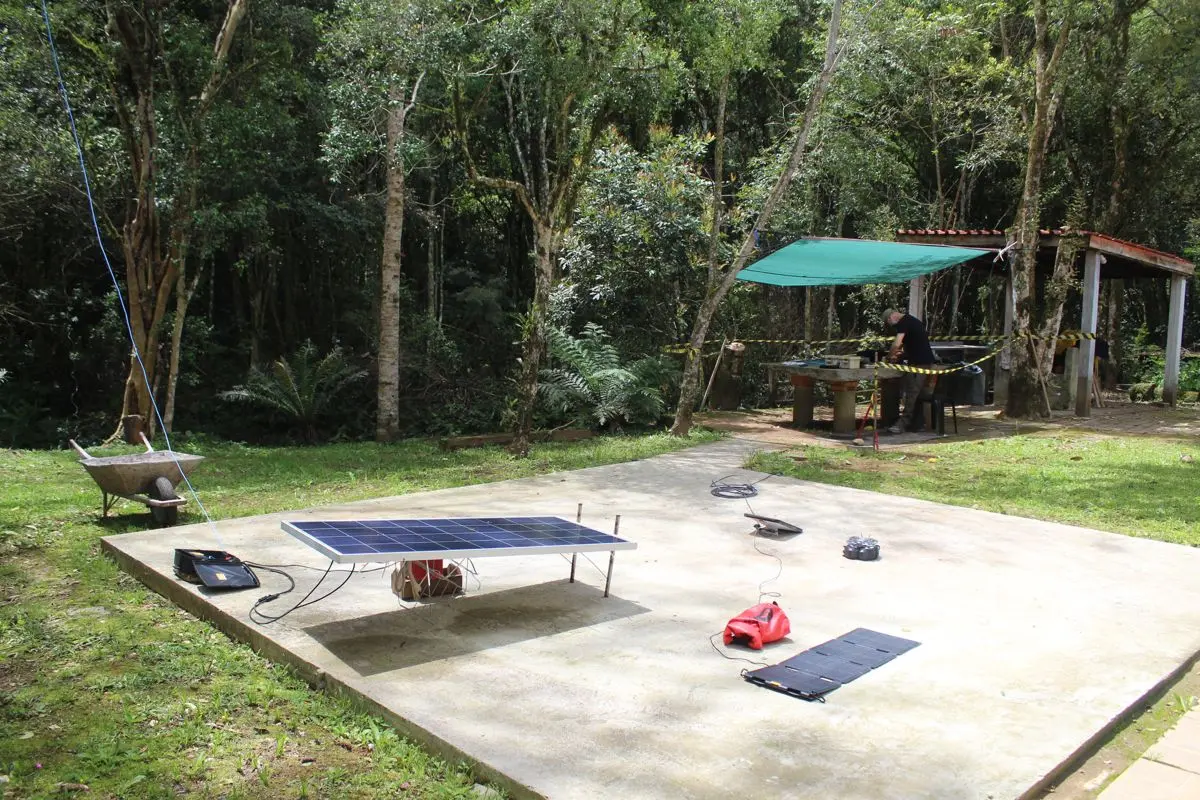
Equipment taken to the field
| Equipment | What it is for |
|---|---|
| 150 W solar panel | Generates power for the Base kit |
| MPPT Charge controller | Charges the battery safely from the panel |
| Battery | Stores power for the night and for cloudy days |
| 24 V step-up | Raises the voltage for devices that need 24 V |
| Inverter | Turns the battery’s power into mains power |
| 50 W USB-C folding solar panel | Portable power source and power bank recharging |
| 65 W and 100 W Power bank | Portable batteries to take to the field |
| 18 V tool batteries | Power for the satellite antenna, with an adapter |
| Stationary battery | Power reserve for the Base equipment |
| Airtight box | Protects the controller and the converters from rain and dust |
| Multimeter, voltage detector and insulating gloves | Safety during setup |
Tested paths, from source to device
| Source | Storage or conversion | Device | Result |
|---|---|---|---|
| 150 W solar panel | Controller, battery, step-up and inverter | Base equipment | Worked |
| Folding solar panel | Direct connection | Satellite antenna | Stable |
| 18 V tool battery | Direct connection, with adapter | Satellite antenna | Stable |
| Folding solar panel | Tripod power bank | Satellite antenna | Stable |
| Pre-charged | 100 W power bank, 1 m cable | Satellite antenna | Failed |
| Pre-charged | Stationary battery | Base equipment | Worked |
Setup order
| Step | Action |
|---|---|
| 1 | Measure the panel and battery voltage |
| 2 | Connect the battery to the controller |
| 3 | Connect the panel to the controller |
| 4 | Switch on the step-up and inverter |
| 5 | Switch on the devices, starting with the satellite internet |
| When taking it apart | Follow the reverse path, disconnecting the battery last |
Looking after the batteries
| Precaution | Why |
|---|---|
| Store them charged, in a ventilated, shaded place | Heat and being stored discharged are what shorten battery life the most |
| Charging and testing routine every 3 months | Makes sure the kit is ready when it is needed |
| Do not get them wet, do not puncture them, take care in transport | Lithium batteries can catch fire when damaged |
| Plan for replacements | As a reference, lithium power banks last 300 to 500 full charge cycles |
See also
Last updated on