How to set up power at the Base without the grid
November 13, 2026
Use this guide when you arrive in an affected area where there is no power grid or it is not reliable. Power is the first thing to be set up at the Base: without it, no other layer works.
Who: two people · Time: about 25 minutes for the Base solar kit · Before you start: Base location chosen and shelter set up
Equipment: Base solar kit (panel, charge controller, battery, step-up and inverter) inside the airtight box, portable power sources (folding solar panel, power banks and 18 V tool batteries), multimeter, voltage detector, insulating gloves and cables.
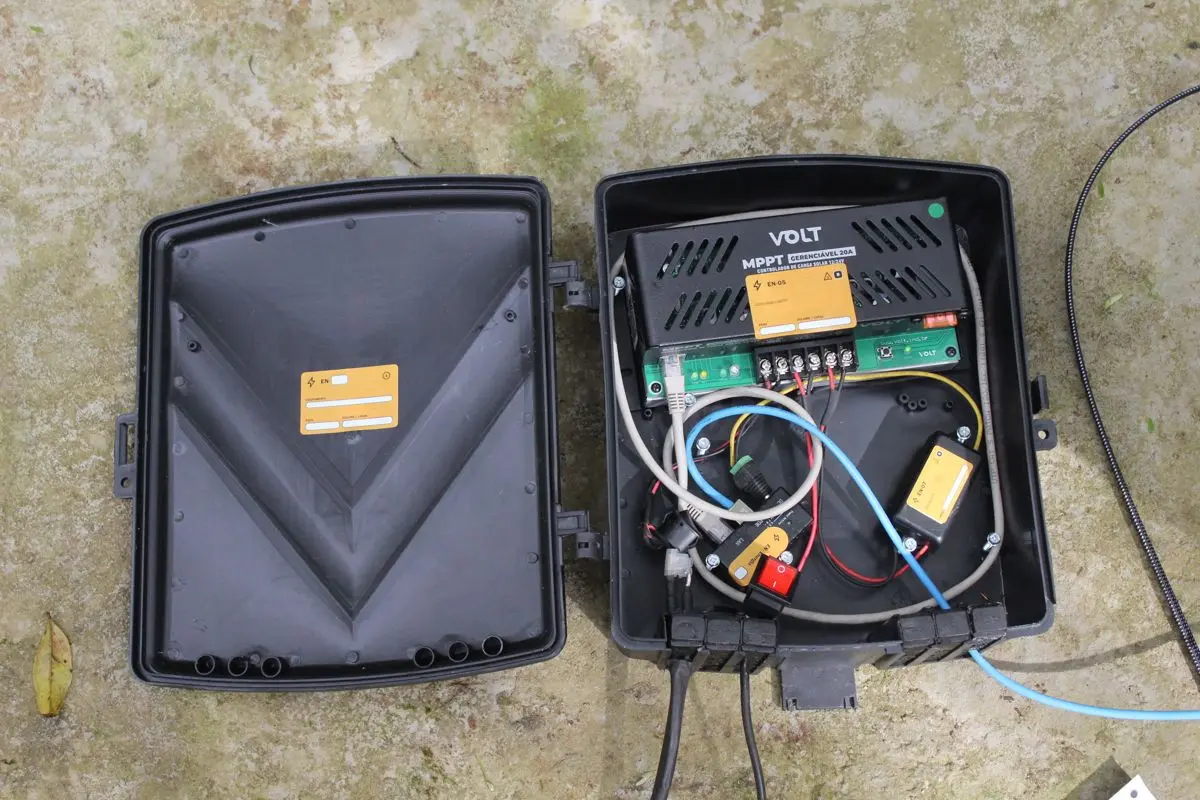
1. Position the panel and the box
- Place the solar panel somewhere that gets sun for most of the day, stable and away from where people walk.
- Face the panel north. Brazil lies south of the equator, so the sun moves across the northern sky during the day.
- Tilt the panel at an angle close to the local latitude. In Rio Grande do Sul, for example, that is about 30 degrees. Near the equator, the panel lies almost flat.
- Keep the panel covered or face down until you connect it to the controller.
- Keep the airtight box under the shelter, near the Base workbench.
- Run the cables along the ground, without crossing walkways, and secure them with tape.
2. Measure before connecting
- Put on the insulating gloves.
- Use the multimeter to measure the voltage at the panel connector and at the battery.
- If any value is outside what the controller manual accepts, do not connect.
3. Switch on the Base solar kit
- Connect the battery to the controller: red cable to +, black cable to -.
- Check on the display that the controller has recognised the battery (12 V or 24 V).
- Connect the panel to the controller and only then uncover the panel.
- Check on the display that the battery is charging.
- Switch on the step-up and the inverter. Only then switch on the devices. Use the inverter only for what needs a mains socket.
To switch on, battery first, then panel. To switch off, panel first, then battery. In the wrong order, the controller can be damaged.
4. Prioritise the internet and the network
- Power the satellite internet first, preferably with the tripod power bank recharged by the folding solar panel.
- Then power the gateway and the access points of the Wi-Fi network.
- Leave radios and LoRa nodes charging on the USB ports that are left.
Do not use the 100 W power bank with a 1-metre cable for the satellite antenna: in the field, the antenna switched on and off non-stop.
5. Keep everything charged during the emergency
- Use the folding solar panel to recharge power banks during the day.
- Always have a charged spare power source for the satellite antenna.
- Every hour, write down the battery voltage and charge and the time of each power source swap. The template is in PACE plan and kit records.
- At night, switch off anything that is not essential.
- In wildfires, smoke reduces the light reaching the panel. Start with all batteries charged and save power from the beginning.
6. When you finish
- Switch off the devices and take everything apart in reverse order: devices, converters, panel and, last of all, the battery.
- Store the batteries charged, in a ventilated, shaded place.
Done when: the battery is charging, the satellite internet and the Wi-Fi network are on and there is a charged spare power source for the antenna.
Precautions
- Do not get lithium batteries and power banks wet, do not puncture them and do not leave them in the sun.
- Check the polarity before each connection. A swapped cable burns out the device.
- Use the voltage detector before touching any wire you did not connect yourself.
- Keep connectors away from water.
See also
Last updated on